
xAI vs. OpenAI: The Insider’s Guide to Landing Your Next AI Role

The AI job market is brutal right now. Rejection emails pile up. LinkedIn feels like shouting into the void. And watching companies like xAI and OpenAI make hiring announcements while you’re stuck in application purgatory? Exhausting.
But here’s what most candidates miss: These two companies aren’t just different employers—they’re completely different games with different rules, different players, and different ways to win.
Last week, we hosted the xAI vs. OpenAI workshop, where we pulled back the curtain on what it actually takes to land offers at these frontier AI labs. What we discovered shocked even us.
The Reality Check Nobody Wants to Hear
xAI has ZERO traditional Product Manager roles.
Let me repeat that: If you’re a PM looking at xAI, you’re looking at the wrong company. They don’t hire PMs. Period.
What they do hire are Technical Product Partners, Product Engineers, and Product Designers—all roles that require you to actually build and ship code. If you can’t open a terminal and contribute to production, you won’t make it past the recruiter screen.
Meanwhile, OpenAI is in full-scale PM expansion mode. With a total workforce ranging between 2,600-6,400 employees (reports vary), they’ve allocated roughly 225 people to Marketing and Product combined—about 8% of the company. And they’re not slowing down: November 2025 alone saw multiple public PM openings across ChatGPT Growth, Ecosystem, ChatGPT for Work, Education, and Developer Tools.
Meanwhile, OpenAI has approximately 225 people across Marketing and Product combined—about 8% of their total workforce. With multiple PM roles currently open (including ChatGPT Growth, Ecosystem, ChatGPT for Work, Education, and Developer Tools), they’re aggressively expanding this function. But here’s the catch: they want 6+ years of PM experience minimum, and they strongly prefer candidates with engineering backgrounds or deep technical strategy experience.
The age profiles tell the story. xAI’s technical product folks average late 20s to early 30s, often with 3-8 years of experience but insane shipping velocity. OpenAI’s PMs? Mid-to-late 30s (35-44 typical), with established track records navigating ambiguous, high-stakes environments.
And the hiring momentum is striking: OpenAI posted their careers page with multiple PM openings throughout November 2025, signaling continued aggressive expansion as their ecosystem, platform, and enterprise GTM teams mature. This isn’t a trickle of hiring—it’s a flood.
These aren’t just different job postings. They’re fundamentally different career paths.
What the Interview Process Actually Looks Like
OpenAI: The Academic Evaluation
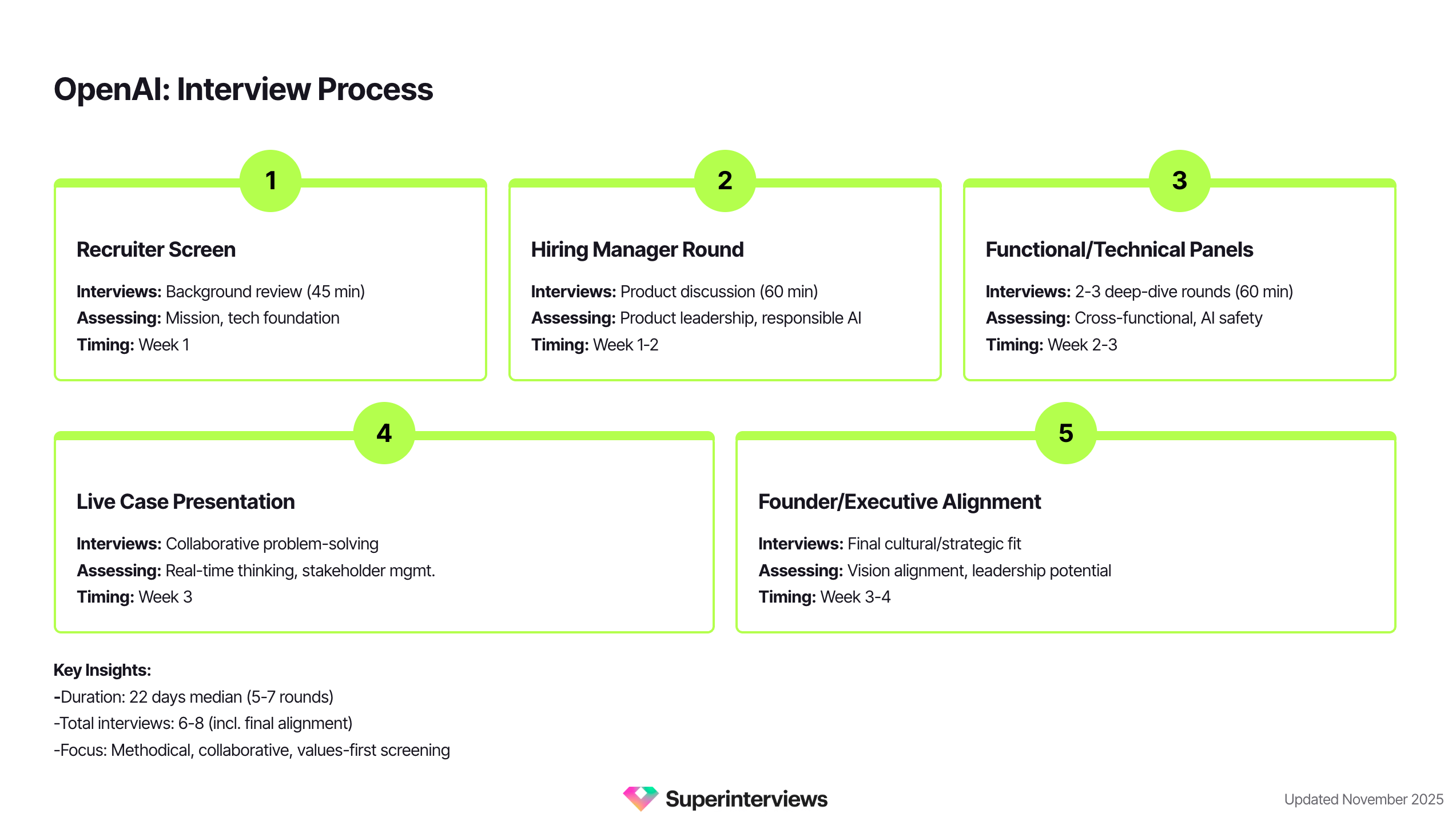
OpenAI’s interview process is methodical, collaborative, and values-first. The median timeline is 22 days with 6-8 rounds total.
Here’s the breakdown:
Recruiter Screen (Week 1, 45 min): They’re assessing mission alignment and technical foundation. Can you articulate why responsible AI matters? Do you understand the weight of what OpenAI is building?
Hiring Manager Round (Week 1-2, 60 min): Deep dive on product leadership. They want to see how you think about product strategy in an AI-first context. Past failures matter here—they’re testing for psychological safety and learning mindset.
Functional/Technical Panels (Week 2-3, 2-3 rounds of 60 min each): Cross-functional depth and AI safety considerations. Expect questions about how you’d navigate trade-offs between shipping fast and shipping safely.
Live Case Presentation (Week 3): Collaborative problem-solving in real-time. This isn’t about having the perfect answer—it’s about how you think through stakeholder management and ambiguity.
Founder/Executive Alignment (Week 3-4): Final round testing vision alignment and leadership potential.
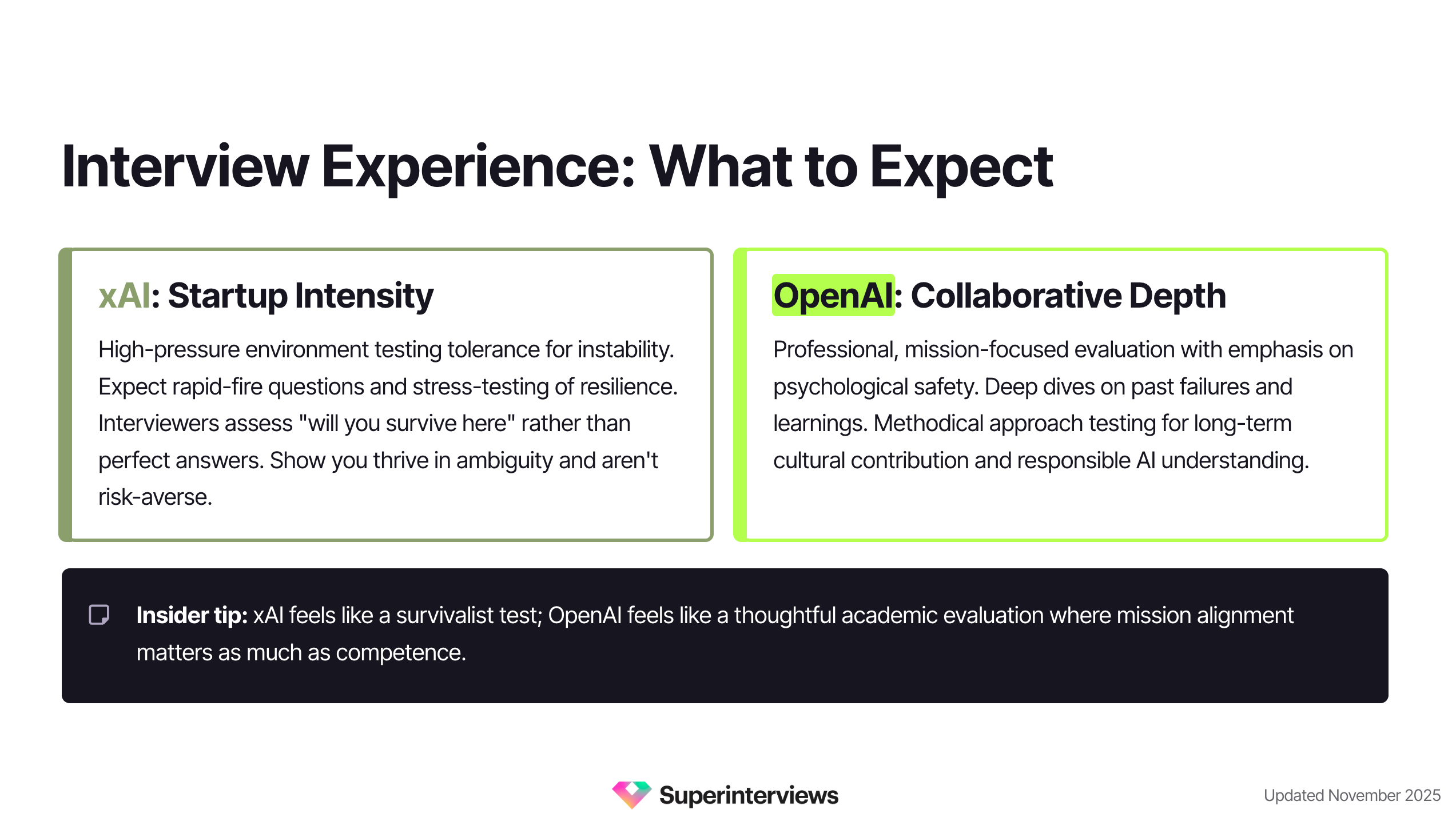
The vibe? Professional. Thoughtful. Mission-focused. As JB put it in the workshop: “OpenAI feels like a thoughtful academic evaluation where mission alignment matters as much as competence.”
xAI: The Survivalist Test
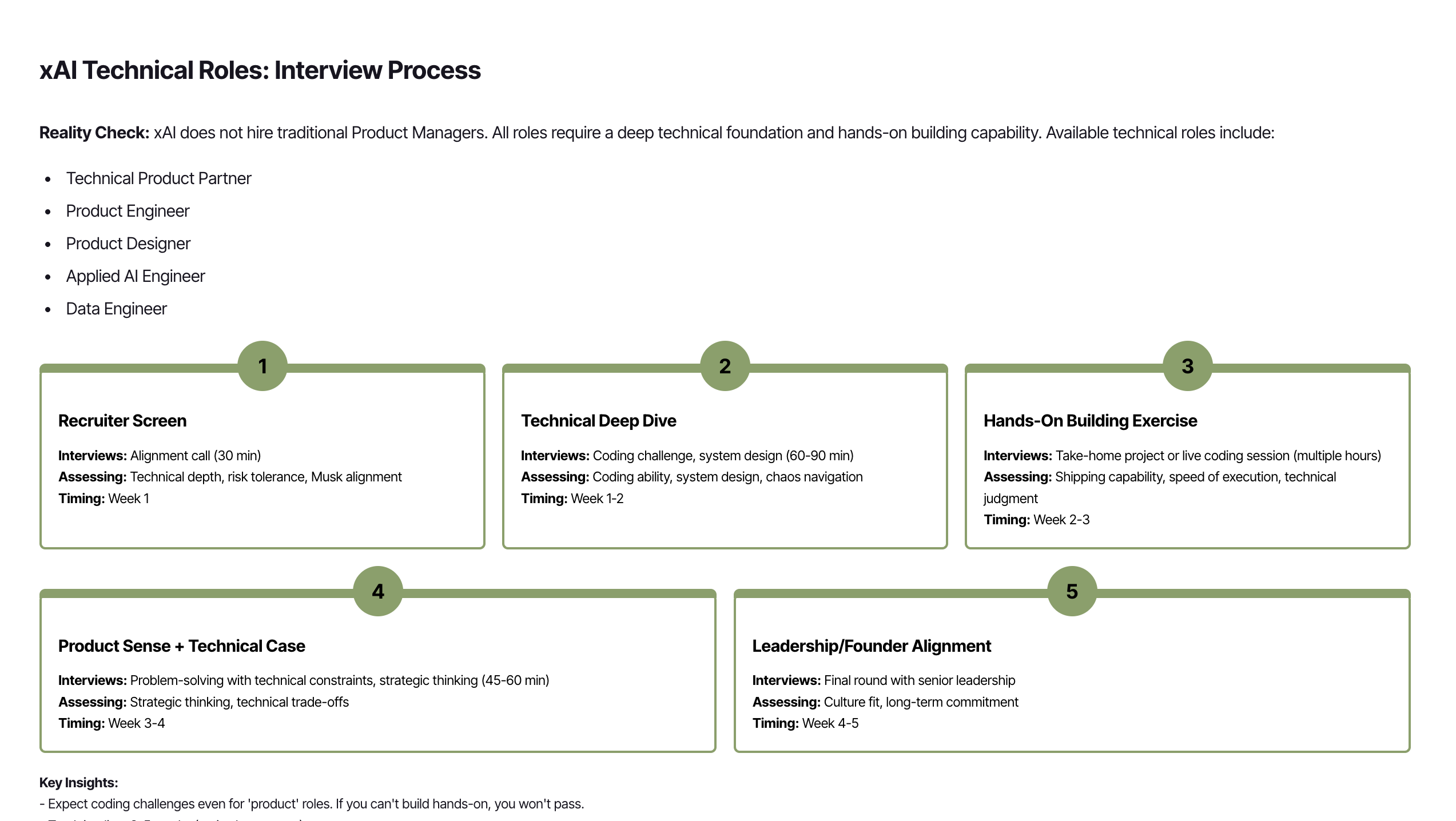
xAI’s process is faster (3-5 weeks), more chaotic, and explicitly designed to stress-test whether you can handle the intensity.
The gauntlet:
Recruiter Screen (Week 1, 30 min): They’re assessing risk tolerance and Musk ecosystem familiarity. Are you comfortable with instability? Can you thrive when the goalposts move daily?
Technical Deep Dive (Week 1-2, 60-90 min): Even for “product” roles, expect coding challenges and system design questions. They need to know you can build, not just strategize.
Hands-On Building Exercise (Week 2-3, multiple hours): Take-home project or live coding session. Speed of execution matters as much as technical judgment.
Product Sense + Technical Case (Week 3-4, 45-60 min): Strategic thinking with real technical constraints. Can you make smart trade-offs when resources are scarce and timelines are aggressive?
Leadership/Founder Alignment (Week 4-5): Final culture fit. Long-term commitment to the mission is non-negotiable.
The atmosphere is high-pressure, rapid-fire, and explicitly testing resilience. Interviewers assess “will you survive here” rather than whether you have perfect answers. You need to demonstrate you thrive in ambiguity and aren’t risk-averse.
The Compensation Reality
Let’s talk numbers because this matters.
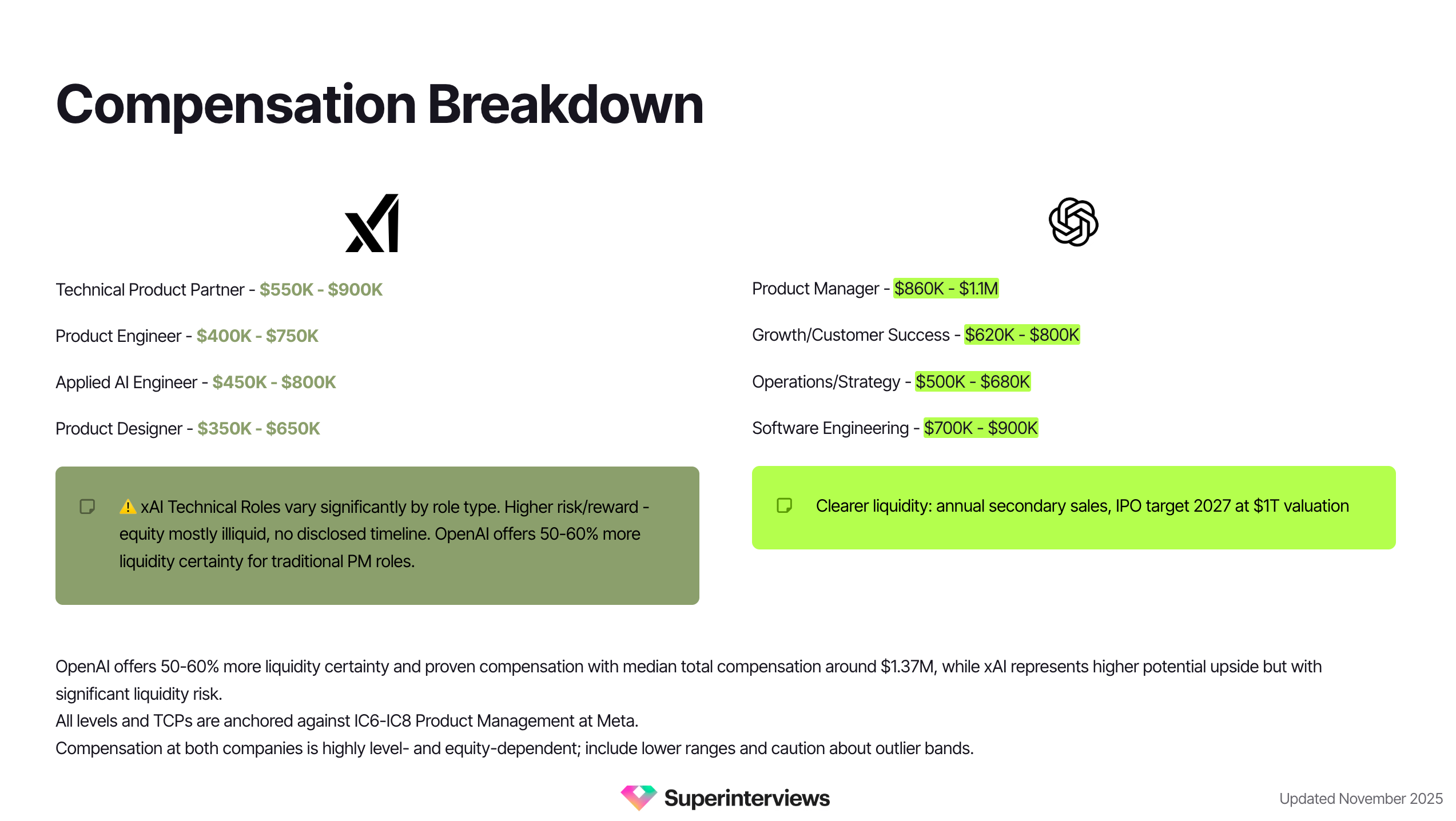
OpenAI PMs: L4 roles start around $350K-$450K total comp (base + equity + bonus). But remember—they’re hiring experienced PMs with 6+ years, so you’re more likely looking at L5 or L6 bands, which push into the $500K-$800K range.
xAI Technical Product roles: Less standardized because they’re not traditional PM roles. Think engineer-level compensation with massive equity upside potential. Early employees at xAI are betting on a 10x private valuation increase before liquidity.
The math is different. OpenAI offers proven compensation with a clearer liquidity path (they’ve already done secondary sales). xAI is maximum risk for maximum potential reward—if you believe in the Musk multiplier and can stomach the volatility.
How to Actually Land the Interview
This is where most candidates blow it. They treat xAI and OpenAI like generic Big Tech companies and wonder why their applications disappear into the void.
For OpenAI:
Show deep engagement with responsible AI. Your LinkedIn should demonstrate you’ve thought critically about AI safety, fairness, and societal impact. OpenAI cares about mission alignment from day one.
Leverage your network strategically. OpenAI values warm introductions from current employees. Don’t cold apply and hope—find connections and get introductions. The Superinterviews platform gives you access to 900+ professionals in our network who can make these intros.
Optimize for the recruiter filter. OpenAI recruiters look for specific signals: technical depth, cross-functional leadership, and evidence of navigating high-ambiguity environments. Your resume and LinkedIn need to scream these qualities.
For xAI:
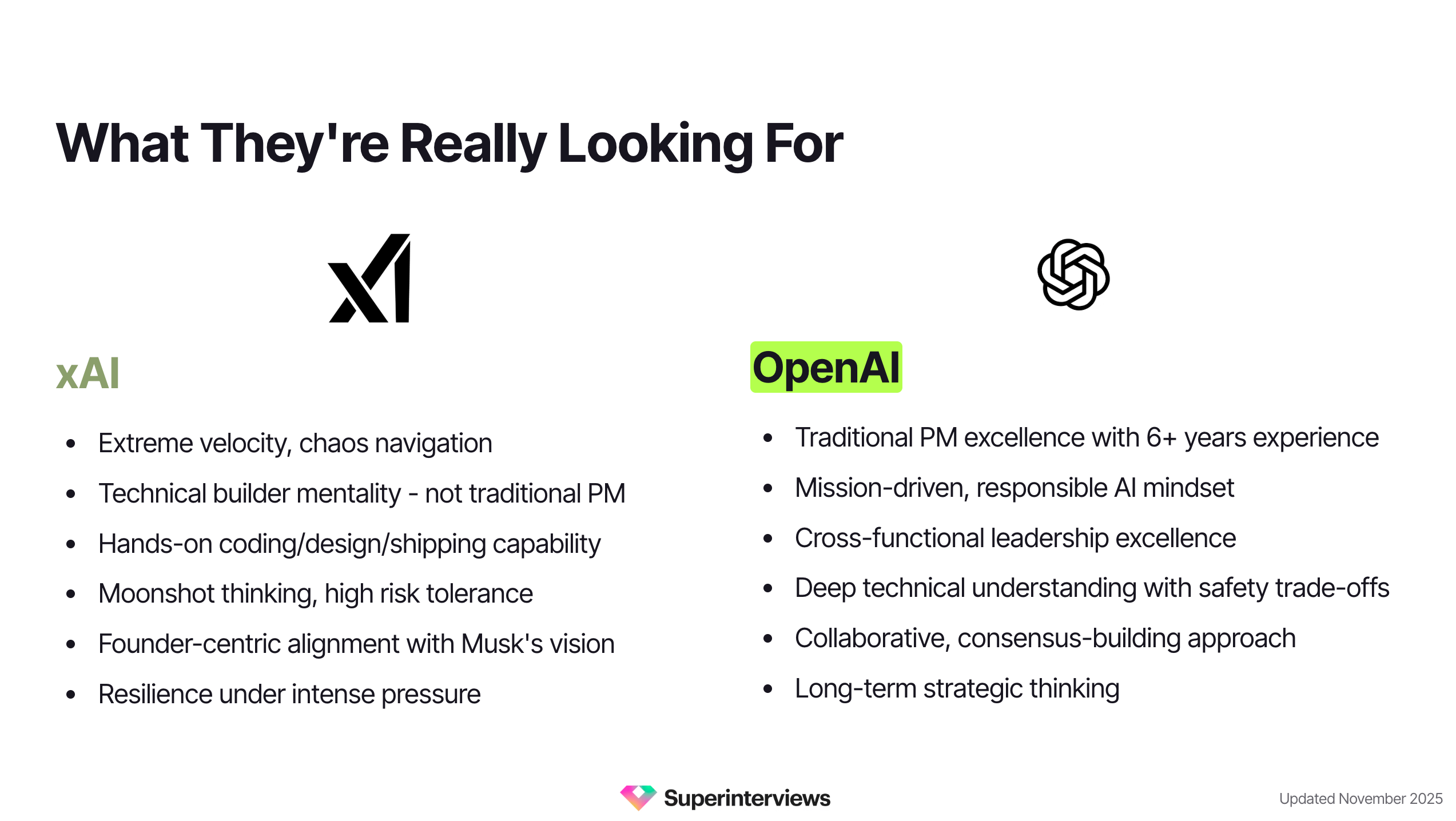
Lead with your shipping velocity. xAI doesn’t care about your PM framework knowledge. They want to see GitHub contributions, live products you’ve shipped, technical projects you’ve built from scratch.
Demonstrate chaos navigation. Your background should show you’ve thrived in fast-moving, resource-constrained environments. Startup experience is gold. So is evidence of autonomous decision-making when you didn’t have clear requirements.
Get comfortable with the Musk ecosystem. Follow what’s happening at X (formerly Twitter), Tesla, SpaceX. xAI isn’t operating in isolation—it’s part of a broader vision. Understanding that context matters.
The LinkedIn Optimizer Strategy
During the workshop, JB walked us through the Superinterviews LinkedIn Optimizer, and the before/after transformations were striking.
Most candidates make three fatal mistakes:
Generic headlines that say “Product Manager” instead of positioning them for the specific role they want
Experience sections that list responsibilities instead of impact and outcomes
About sections that read like cover letters instead of compelling narratives
The LinkedIn Optimizer inside Superinterviews fixes this by analyzing your profile against what recruiters at frontier AI labs actually look for. It gives you specific, actionable feedback on your headline, summary, and experience sections—the three parts that matter most.
As one workshop attendee noted: “I thought my LinkedIn was fine. Turns out ‘fine’ is the kiss of death when you’re competing against hundreds of other candidates.”
The AI Mock Interview Game-Changer
Here’s something we demonstrated live: Superinterviews lets you practice with AI interviewers tailored to specific companies and roles.
Want to practice for an OpenAI PM role on the Codex team? The system builds out company-specific questions, creates a detailed rubric based on what OpenAI actually evaluates, and gives you real-time feedback on your answers.
Susan, one of our workshop volunteers, practiced a recruiter screen for an OpenAI PM role. Within minutes, she was getting feedback on:
How well she articulated mission alignment
Whether her technical depth came through
If she asked insightful questions about the role
Where her delivery could improve
The key insight from JB: “We focus on the feedback. There are tons of interview question banks out there. What candidates actually need is to see their gaps and get better.”
You can throw in your own questions too. If you’ve seen a specific question on Reddit or Glassdoor that you want to practice, just add it to the system and it’ll build a rubric to evaluate your response.
The Culture Fit Reality
This matters more than you think.
OpenAI’s culture: Collaborative, mission-driven, process-oriented. They value psychological safety and want people who can admit mistakes and learn from failures. If you need clarity and structure to thrive, OpenAI’s methodical approach will serve you well.
xAI’s culture: Intense, scrappy, bias-toward-action. They want people who can make decisions with incomplete information and won’t freeze when priorities shift daily. If you need consensus and detailed roadmaps, you’ll hate it at xAI.
Neither culture is better. They’re just radically different. Misalignment here is why so many candidates get offers and then struggle once they’re in the role.
The Special Offer (Ending Sunday 11/9)
For workshop attendees who grab Superinterviews before end of day Sunday, here’s what you get:
The Platform ($8,999 value for $299):
AI mock interviews for any role
LinkedIn Optimizer with company-specific feedback
Unlimited AI resume writing optimized for ATS systems
Access to 1,000+ person community of job seekers
Warm intro capabilities to 170K+ professionals
The Bottom Line
If you’re targeting xAI: Stop applying as a PM. Assess whether you have the technical chops to be a Product Engineer or Technical Product Partner. If you can’t code, look elsewhere. If you can build and thrive in chaos, xAI offers maximum upside with maximum risk.
If you’re targeting OpenAI: Lean into your PM experience and demonstrate deep AI safety awareness. Get warm introductions. Show methodical thinking and cross-functional leadership. OpenAI offers mission-driven impact with sustainable career progression.
If you’re targeting both: You probably need to decide which game you’re playing, because the skills and positioning required are fundamentally different.
The AI job market is brutal, but it’s not random. Companies like xAI and OpenAI have clear playbooks. Most candidates just don’t know what they are.
Now you do.
Ready to make your move?
The 24-hour workshop offer ends Sunday at midnight. Get everything you need to land your next AI role at the best price we offer all year.
👉 Claim your spot in Superinterviews
Your next role is waiting. Let’s go get it.
— JB & Kasey
Superinterviews
P.S. If you’re experiencing financial insecurity or on SNAP benefits, email fairyjobmother@teamsidebar.com. We’ll work directly with you to get you access.