
Make Hiring Managers Fight For You
How Deb Liu’s Meta Interview Secrets Can Transform Your PM Career

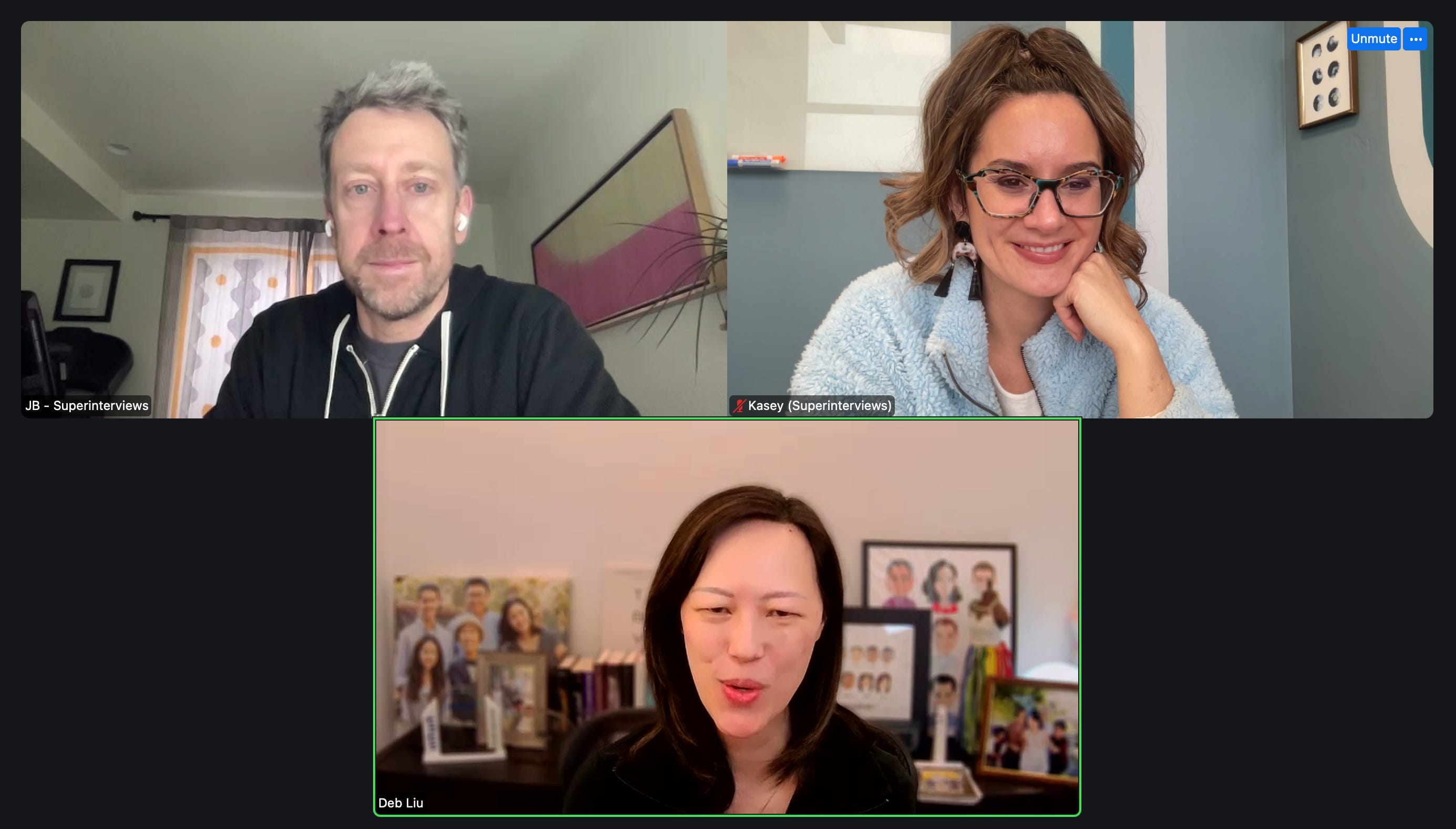
Welcome to what might be the most important deep dive you read this job search season. Yesterday, we had the incredible privilege of hosting Deb Liu—yes, the Deb Liu who literally invented the product manager interview process at Facebook and has hired thousands of PMs across her legendary career at Meta, Ancestry, and beyond.
The timing couldn’t be more critical. We’re in the worst job market since 2003, with U.S. companies shedding 20,000 jobs per month since April. Yet despite these brutal conditions, our Superinterviews community has landed $14 million in offers at Google, Meta, Stripe, Pinterest, and more—all in the last 6 months.
How? By mastering exactly what Deb revealed in this workshop: interviewing is a completely different skill than doing the job itself. And when you learn this skill, you stop being screened out by the very companies where you’d thrive.
In this deep dive, you’ll discover the insider strategies that shaped Meta’s hiring machine, the exact mistakes that get stellar candidates rejected, and the frameworks top PMs use to create FOMO in hiring managers. Plus, we’re including all the free resources, workshop replay, and special offers mentioned throughout.
Watch the full workshop replay here →
The Challenge: Why Great PMs Fail Interviews
Let me paint you a picture that Deb shared—one that should wake us all up.
She had a team member who was already performing the PM role successfully at Meta. He knew the products, understood the users, shipped features, and worked collaboratively with engineering and design. By every objective measure, he was a product manager.
Then he interviewed for the official PM position. And he failed.
Not because he lacked hard skills. Not because he couldn’t do the job—he was literally already doing it. He failed because he couldn’t communicate his experience in a way that landed with interviewers.
“Even as his hiring manager, I couldn’t get him through,” Deb revealed. “And that’s when I realized just how dangerous the interview process is. You could have all the skills and still fail.”
This story repeats itself constantly. Brilliant PMs freeze up. Introverts who process thoughtfully get outshone by fast talkers. People with incredible track records can’t articulate their contributions clearly. The gap between capability and interview performance costs talented people hundreds of thousands of dollars in lost opportunities.
The transformation available? Learning to close that gap—not by becoming a different person, but by mastering the specific skill of interviewing.
How Deb Liu Built the Meta PM Interview Machine
The System Before
When Deb took over PM recruiting at Facebook, the system had serious blind spots. It required a CS degree. It included a technical coding interview. There was a “futurist” interview that assessed candidates’ ability to dream big.
These seemed reasonable on the surface. But when Deb’s team analyzed the data on who actually succeeded long-term as PMs, the results were startling.
The Revolutionary Changes
They removed the CS degree requirement. Why? Because incredibly successful PMs were coming from product marketing, operations, and non-technical backgrounds. “I have a civil engineering degree,” Deb shared. “All my engineers would send me diffs and I’d be like, ‘Please don’t do that, because I have no idea.’ But I led a massive engineering team.”
They eliminated the technical coding interview. The question became: do you really need to answer engineering questions to lead a team to build great products? The data said no.
They removed the “futurist” interview. Here’s the kicker—this interview was uncorrelated with success. Worse, it filtered out people who felt they had less permission to dream big because of their backgrounds. “It turns out four-week hires means you should not get hired, because nobody felt strong enough to fight for you,” Deb explained. “The ones who were hired tend to be the most polarizing in some ways, because they had an opinion.”
They doubled down on what actually mattered. Self-awareness. Leadership and drive. The ability to articulate your specific contribution versus your team’s contribution. Collaboration in zero-sum situations. Being a giver, not a taker.
What Actually Predicts Success
Through thousands of interviews and performance reviews, Meta discovered that soft skills screen out more candidates than hard skills. Most people who get to the interview stage have the technical capabilities. Where they trip up is communication, self-awareness, and cultural fit.
“The problem isn’t your hard skills. If you made it through the resume review, you’re probably pretty close on the hard skills,” Deb shared. “It’s really about, is this person someone I want on my team? Is this somebody I can work with?“
The Fatal Mistakes That Tank Strong Candidates
Mistake #1: Using “We” Instead of “I”
This is especially common among women and underrepresented groups. Candidates say “our team built this product” or “we achieved 300% growth.”
In the interviewer’s head? “What did YOU do?”
“I see this happen so much,” Deb said. “It’s like, ‘We did...’ and I’m like, the royal we? Like, you could have done nothing, or you could have been the leader. If you’re unable to articulate what your role was, it just leaves these questions in the mind of the interviewer.”
The fix: Use “I” statements with specific contributions. “I led the strategy that resulted in...” “I identified the opportunity and drove alignment across...” “My analysis revealed...” Don’t be afraid to own your wins.
Mistake #2: The Fake Weakness
You know this one. “What’s your greatest weakness?” “Well, I work too hard.” Or “I failed to maintain work-life balance.”
Interviewers can smell this from a mile away—and it screams lack of self-awareness.
Deb’s counter-move is genius: “What did it say in your last performance review you need to work on? What did your manager tell you? What were the three things that you need to work on, and what did you do about them?”
“Now, you can lie to me,” Deb admitted. “Or you can articulate on the fly what your manager told you. But that tells you a lot about somebody. I care less about what those three things are, I care that they remember, that they reflected on it, and that there’s something they did about it.”
Mistake #3: No AI Proficiency to Show
A recruiter told Deb recently: if a resume doesn’t show AI experience, some companies immediately discard it.
“The biggest issue is that people just kind of say, ‘Well, I’m AI proficient’ without showing any real skills or, like, something they built,” Deb explained. “What happened with mobile was they were looking for mobile PMs. Well, it turns out that there were very few mobile PMs, and so we had to retrain an entire generation of people. If you’re not retraining quickly, you’re gonna be left behind.”
The fix: Show, don’t tell. Build something with AI tools. Deploy an AI feature. Use video coding platforms. Share specific tools you’ve mastered and results you’ve generated.
Mistake #4: Inability to Think on Your Feet
We have a bias toward people who can answer quickly and articulately. Fair or not, meetings go to the person who talks fastest and takes up space.
“I had one PM I worked with, she’s brilliant,” Deb shared. “She didn’t say anything at the meeting. Like, we had these executive meetings with the executives of the company, and she didn’t say anything. She’s like, ‘I’m a processor, and by the time I think of what to say, it’s already passed.’”
This PM was objectively brilliant, but she wasn’t showing her skills in the moments that mattered.
The fix: Practice, practice, practice. Have your stories top of mind. Know what you’re going to say for standard questions. If you’re an introvert or a processor, this preparation is non-negotiable.
“The questions are not that different from interview to interview,” Deb reminded us. “What they’re looking for is slightly different, so make sure you understand that. But if you don’t have a story top of mind for each of them, you’re really missing out, especially if you’re a processor.”
Mistake #5: Landing vs. Saying
Here’s the framework that changed everything for me: Intent → Behavior → Perception.
Your intent might be right. Your story might be perfect. But if their perception doesn’t match your intent, you’ve failed.
Deb gave a brilliant example from her own career: “I spent years advocating for Facebook Marketplace. At a scrappy company like Meta, you could just lobby wherever you want for as many years as you wanted to. But I’m sure a lot of companies they’d perceive that as ‘annoying, why would she do that’. If I worked in a very hierarchical company, they’re like, ‘she must be a very annoying person to work with.’”
Same story. Same intent. Completely different perception based on company culture.
The fix: “Don’t answer the questions, like, don’t think about what you’re saying, think about what’s landing. And think about whether what they’re hearing is what you’re truly conveying.”
Company-Specific Deep Dive: Meta vs. Everyone Else
One of the most valuable insights Deb shared: Meta and Google are nothing alike, despite people applying to both as if they’re interchangeable.
Meta’s Interview Structure
Meta looks for:
Scrappiness over process. Can you move fast and lobby for ideas?
Self-awareness. The leadership and drive interview tests whether you can reflect on failures
Impact at scale. They want to know you can build products for billions
Opinion and polarization. Four-week hires (everyone says “maybe”) typically don’t get hired. Strong hires are polarizing because they have clear points of view
What This Means for Your Stories
If you’re interviewing at Meta, your Facebook Marketplace-style persistence story plays brilliantly. If you’re interviewing at a fintech company with regulatory constraints? That same story makes you look reckless.
“Different teams within Google are very different, and the same thing at Meta,” Deb explained. “At Microsoft, the AI team is completely different than the Windows team and the Office 365 team. Don’t think about what you’re saying, think about what’s landing.”
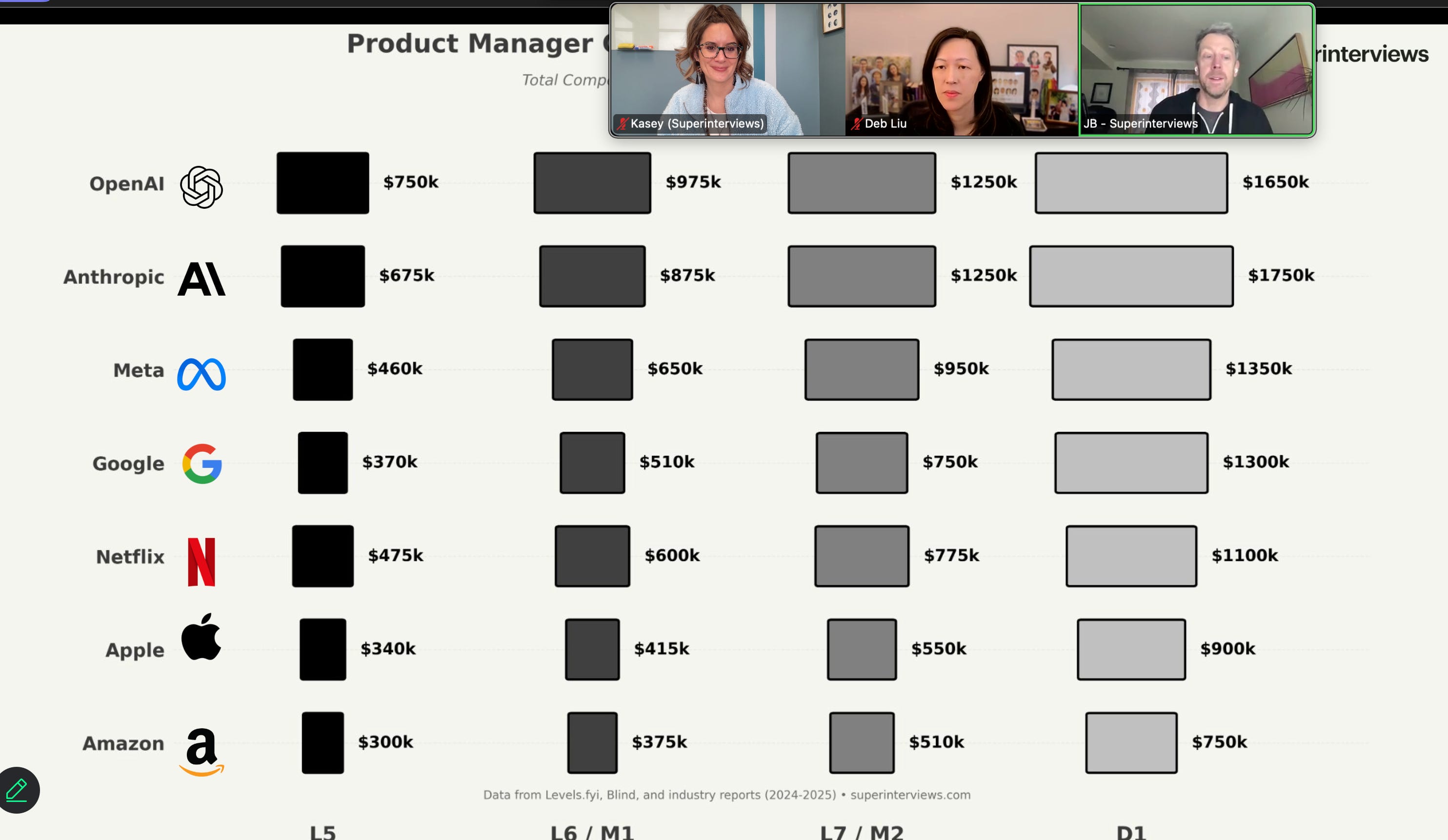
OpenAI vs. Anthropic Example
These companies are both doing frontier AI work. But they’re hiring for completely different qualities:
OpenAI: Scrappy, move-fast culture
Anthropic: Safety-first, enterprise-focused
Your stories need to match the culture you’re interviewing for, not just the role.
The FOMO Factor: Making Hiring Managers Fight For You
The candidates Deb fought hardest to hire? The ones where she thought: “We are a worse company because this person is not here.”
Not “they seem like a solid hire.” Not “they check the boxes.” But “we would be lucky to have this person on our team.”
How do you create that FOMO?
Show Them Something They Don’t Have
“On the other side, the person listening to you sees that you are going to bring something new to the table that they don’t already have.”
This is especially crucial with AI right now. Don’t just say you’re “AI proficient.” Show them:
Specific tools you’ve deployed
Results you’ve generated
Novel approaches you’ve discovered
How you’ll bring that magic to their organization
Make Them Hungry
“You want them to want you so much that they get FOMO,” Deb said. “The hiring managers would fight over the best candidates because we’re like, we want that.”
Connection matters more than perfect answers. “At the end of the day, you want them to want to want to work with you. That’s how people hire. You can have all the right answers, and the other person still thinks, ‘I just don’t know if I want to work with that person.’ You would be a no.”
Landing the Interview: Pre-Interview Strategy
Before you even get to practice your answers, you need to get the interview. Here’s what’s working in 2025’s brutal market:
Stop Spray-and-Pray Applications
One startup founder Deb advised posted a PM role and got 900 resumes in a week. By the time he made an offer? 1,800 resumes.
“How do you rise above when it’s just raw submission?” Deb asked. “It’s really the person who connected with him that made it work.”
Instead of 800 resumes, send 8 amazing contacts.
The Relationship Moat
“It’s the oldest moat in the book, and the newest moat in the book,” as we discussed in the workshop. Build authentic connections:
Connect with people at target companies on LinkedIn
Comment thoughtfully on their posts
Share insights about their product
Offer value before asking for anything
Deb gave a perfect example: “I advise startups, and I wasn’t purposely looking to advise them, but I just sent them feedback, ‘hey, here’s 5 things that you could do better in your product,’ and they messaged back, ‘do you want to advise us?’”
Show Don’t Tell: The Portfolio Approach
Don’t just say you love a company’s product. Actually use it and build something.
For AI PM roles specifically:
Build something with vibe coding platforms
Deploy an AI feature in a side project
Create a case study of AI tool evaluation
Share specific frameworks you’ve developed
“Even if it’s not within your current job, show that you’re proficient,” Deb advised. “Show that you’ve tried these tools. Show that you could bring that magic to the organization.”
Crushing the Interview: The Practice Framework
Here’s the truth bomb Deb dropped: Interviewing is a completely separate skill from doing the job.
“People say, ‘oh, if I just articulate that I could do the job, they’re gonna hire me.’ But oh no, interviewing’s a different skill than doing the job.”
The Six-Sentence Rule
If you can’t land your message in six sentences, you’ve lost them.
“If you can’t get to the point of where you’re trying to go in 6 sentences, they’re just, like, they’re starting to think about their grocery list, or what else they’re gonna do,” Deb explained. She compared it to following characters in Assassin’s Creed. Wander too long and you lose the thread entirely.
Practice being concise. Deb actually used Superinterviews herself to practice, and even she scored as a weak hire initially on her own interview process.
“There’s a reason,” she admitted. “I built a product that went from nothing to a billion people, but I’m not great at interviewing about my product list. You need this feedback.”
Have Stories Ready for Every Question Type
The questions don’t vary that much between companies. What varies is what they’re looking for in the answers.
Prepare stories for:
Leadership and Drive: Times you pushed for something no one believed in, failures you overcame, decisions you made with incomplete information
Product Sense: How you identified opportunities, prioritized features, understood user needs
Analytical Thinking: How you used data to make decisions, trade-offs you navigated
Technical Acumen: How you worked with engineering, technical decisions you influenced
Cross-functional Collaboration: How you aligned stakeholders, resolved conflicts
The Deb Liu Practice Method
When Deb coaches candidates (or high school students getting their first internships), she stops them mid-answer:
“Just tell me your story. And I’d stop [them and say] ‘no. Say it again in 6 sentences. It was too long. You didn’t get to the point.’”
Getting that immediate feedback—trying it multiple times until it lands—is how you build the muscle.
AI PM Interviews: The New Frontier
What Companies Mean by “AI PM”
First, get crystal clear on what AI PM means at your target company:
AI-first products (building the AI itself)
AI features in SaaS products
AI tools for PM productivity
All of the above
Research on Perplexity, Blind, Reddit, Glassdoor, and industry sources like Akash Gupta and Lenny’s Newsletter to understand company-specific definitions.
What They’re Actually Looking For
Beyond AI experience, they want to see:
Specific tools mastery: Which prototyping tools, why you chose them
Trade-off thinking: When to use AI vs. when it adds friction
Product sense fundamentals: AI doesn’t replace core PM skills
Intellectual humility: Acknowledging that everyone’s still figuring this out
The capacity to talk to it, your stories really using it, and then if you have a vibecoding interview, it’s the same product sense that you need regardless of whether there’s AI involved or not.
Building Your AI Portfolio Fast
You don’t need a six-month bootcamp. Deb and team are running two-day bootcamps specifically for PM AI proficiency.
“This is not like those coding bootcamps where everybody had to learn to code. This is much simpler, it’s much easier to show proficiency. Once you get used to the tools and it’s part of your workflow, it’s totally different.”
Try a hackathon. Take a weekend bootcamp. Just start doing—the intimidation is worse than the actual learning curve.
People Manager Interviews: What’s Different
With AI changing individual contributor roles, people manager positions now require both IC skills AND leadership qualities.
What interviewers look for:
Followership: Do people want to work for you?
Talent magnetism: Will you attract or repel great people?
Care for others: Genuine investment in team success
Performance management: How you’ve handled difficult conversations
The question that reveals everything: “How would you deal with having to fire somebody? What did you do?”
“How someone did it mattered more than the fact that they had to do it,” Deb explained. “How would you manage performance?”
📚 Your Workshop Resources
Free Resources
Workshop Replay: Access the full Deb Liu workshop recording here
Slack Community: Join our free community of job seekers supporting each other
Join here →
Workshop Materials
Workshop slide deck →
Deb’s interview frameworks →
Practice question templates →
Superinterviews Platform
Everything we built to help you win:
Build your network with hiring managers and recruiters (220K+ connections on LinkedIn)
Edit your LinkedIn that gets recruited (one of our customers got recruited to Anthropic the day after they used it)
Optimize your resume so it passes the systems that filter thousands of applications down to dozens that get seen by actual humans
Practice real interview questions, out loud, on-demand, that’ll make you sweat like the real thing and reveal your blind spots before they get you rejected
Join a community that makes this search feel less lonely, more fun, and about growth instead of dejection (weekly group office hours)
Remember, we’re offering 50% off Superinterviews through Sunday night. Access until you land your next job (or six months...whichever comes last). We’ve got everything you need to power your job search.
🎯 Your Next Steps
This Week
Choose your target. Stop trying to be everything. Pick 3-5 companies where you’d genuinely thrive and can articulate why.
Audit your LinkedIn. Does it clearly position you for the role you want next? Or is it generic?
Identify your top 5 stories. Map your experiences to standard interview categories: leadership, product sense, analytical thinking, collaboration, failure/growth.
Practice out loud. Record yourself answering one question. Watch it back. Would you hire this person?
Start building relationships. Connect with 5 people at your target companies. Comment on their posts. Offer value.
This Month
Optimize your resume for each specific role (not one generic version)
Practice 20+ interview questions with feedback (friends, coaches, or AI tools)
Build your AI portfolio with at least one concrete project you can discuss
Get warm introductions to at least 3 people at target companies
Refine your six-sentence story for each major experience
🎁 Exclusive Workshop Offer (24 Hours Only!)
For attendees of this workshop, we’re extending a special opportunity to join Superinterviews at the lowest price we’ve ever offered.
What you get:
Complete platform access until you land your next job (not a monthly subscription!)
LinkedIn Optimizer with profile reviews
AI Mock Interviews for any company, any role
ATS-Optimized Resume Builder
Warm Intros to 900+ Super 50 professionals
Company Deep Dives and insider interview research
Weekly Office Hours with our team
Slack Community support
Investment: One-time payment of $299 (versus $100/month or $9,000+ in value)
BONUS for fast action:
Purchase before December 22, 2025 and get exclusive access to our “New Year, New You LinkedIn Glow-Up Party” with our CEO Lexy in January. Where we’ll help you optimize your LinkedIn, strategize your networking approach, and build momentum for 2026.
Our Guarantee: Practice 20 interview questions in your first month. If you don’t improve, send us an email. We’ll refund you. We want you to win.
Offer expires Sunday, December 22nd at midnight PST
The Path Forward
Look, I’m not going to sugarcoat it. This is the most unforgiving job market since 2003. Companies are still laying people off. The competition is fierce. AI is changing everything about how we work and how we interview.
But here’s what I know after coaching hundreds of people through this market over the past six months:
The people who win are the ones who treat job search as a skill to master, not a lottery to endure.
They choose their targets strategically. They build real relationships, not just spray-and-pray applications. They practice interviewing like they’d practice any other professional skill. They show up with stories that land, not just credentials that qualify.
They create FOMO in hiring managers because they’ve done the work to understand what each company uniquely needs and how they specifically can deliver it.
You have everything you need to be one of those people.
Deb’s frameworks? Check.
The insider knowledge of what companies actually look for? Check.
The tools to practice and improve? Check.
A community of people fighting alongside you? Check.
What happens next is up to you.
“We just have one job,” as JB reminded us, “and that’s to help you win. We want you to land that job that you deserve.”
Your move, Dream Team. Let’s make 2026 the year you get the role that’s meaningful, impactful, at the level you want, and the income you deserve.
The interview won’t be the thing that stands in your way.
P.S. Huge shoutout to everyone who asked incredible questions in the workshop—your engagement made this conversation even richer. Special thanks to Deb for her generosity in sharing these insights (seriously, the woman invented this process and she’s giving it away for free).
And a personal note: I’ve been the Fairy Job Mother for hundreds of professionals now. Nothing brings me more joy than seeing someone finally break through after months of struggle. Your breakthrough is coming. Keep going.
P.P.S. Don’t forget to join our free Slack community—even if you’re not ready to invest in Superinterviews yet, the community alone is worth its weight in gold. People helping people is our secret weapon.
Drop your biggest takeaway from this workshop in the comments. What’s the one thing you’re going to implement this week? Let’s hold each other accountable.
Now go get that dream job. 🚀
Kasey, The Fairy Job Mother
GTM & Community Lead, Superinterviews