
AI-Native vs. AI-Enabled: The Framework That's Landing $300K+ Offers
Su Belagodu's complete guide to positioning yourself for AI growth roles—plus the four-pillar framework top companies use to hire (and candidates miss)

Hey Dream Team!
WOW. Can we just take a moment to appreciate what we all built together today? The energy, the questions, the breakthroughs – you all SHOWED UP, and we’re so grateful you spent your Halloween with us talking about the future of AI GTM instead of, you know, trick-or-treating. 😄
Today we dove deep into the critical differences between AI-native and AI-enabled growth strategies with the incredible Su Belagodu, who’s not just teaching this stuff – she’s literally building it in the trenches. If you felt like you just took 4 master classes, you’re not alone. Kasey said it perfectly during the workshop!
Watch the Full Workshop Replay Here
🔥 10 Key Takeaways from Today’s Workshop
1. AI-Native vs. AI-Enabled: Know What Game You’re Playing
This is THE framework that will transform how you position yourself in interviews. As Su explained, these aren’t hierarchy levels – they’re entirely different operating contexts, and your go-to-market strategies, hiring, and interviewing need to reflect that.
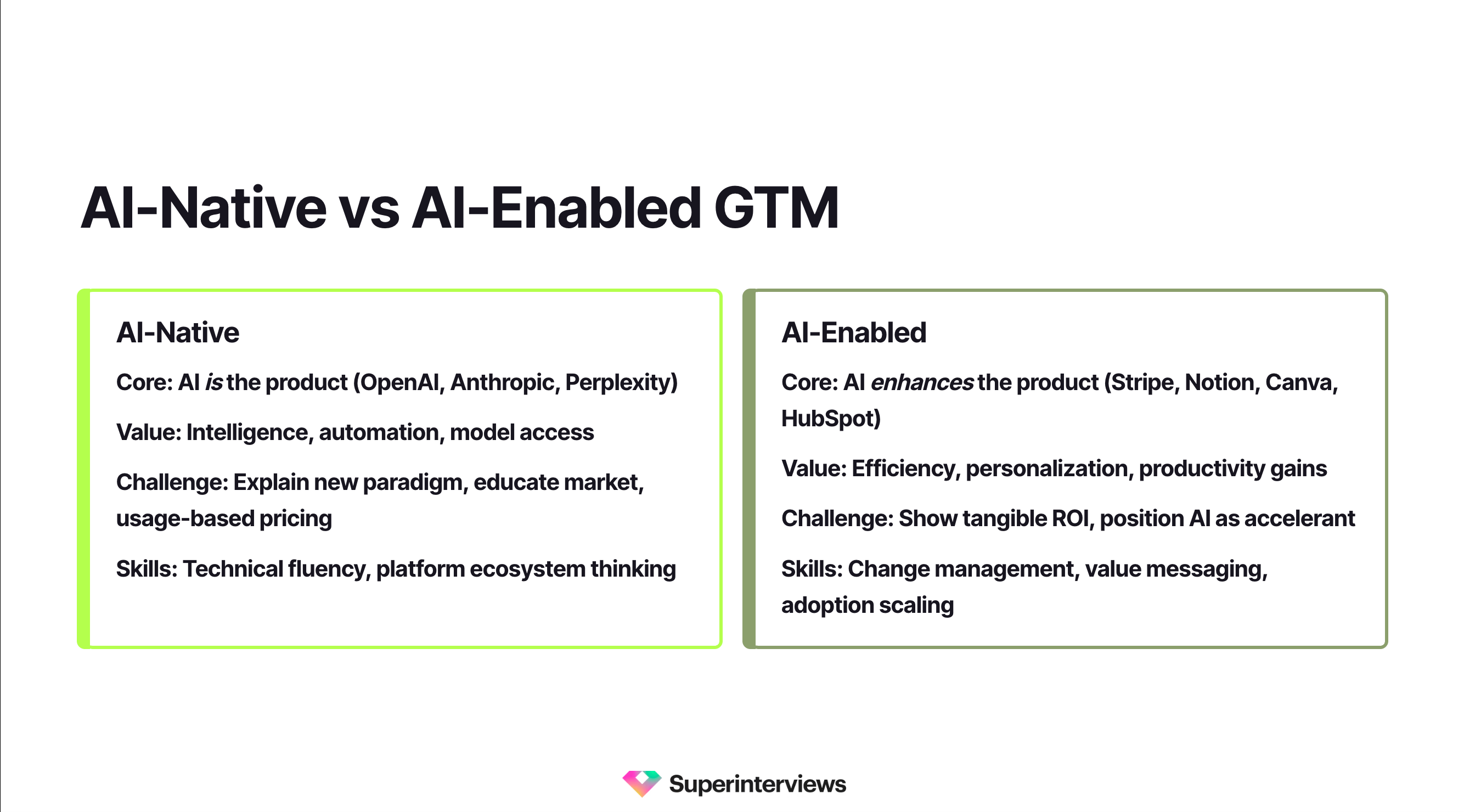
AI-native means AI IS the product – think OpenAI, Anthropic, or Hugging Face. You’re selling a paradigm shift, a brand new way of doing something. The value proposition centers on intelligence, automation, and the model itself. As Su described from her co-founding experience, building an AI-native test automation product meant explaining an entirely new way of doing something that the market was already familiar with doing differently.
AI-enabled means AI ENHANCES the product – think Notion, Canva, HubSpot, or Superinterviews. You’re selling productivity and efficiency gains. The value is in ROI and customer benefit. Su put it perfectly: you’re not selling the AI technology, you’re selling how that technology makes your customer’s life better.
The distinction matters because in interviews, your responses reveal which game you understand. When asked about pricing strategy, an AI-native candidate asks about token usage and compute costs. An AI-enabled candidate asks about ROI proof points for the CFO. Both answers are brilliant – but only if you know which company you’re talking to.
Want to nail this positioning? Our LinkedIn Optimizer helps you craft your profile to speak the right language for the roles you’re targeting. Instead of generic “AI experience,” you’ll showcase the specific frameworks and thinking patterns that AI-native or AI-enabled companies are desperately seeking.
2. The Four-Pillar Framework for AI GTM Success
Su broke down her systematic approach to evaluating and discussing AI go-to-market strategies. Master this framework, and you’ll walk into every interview with crystal-clear positioning:
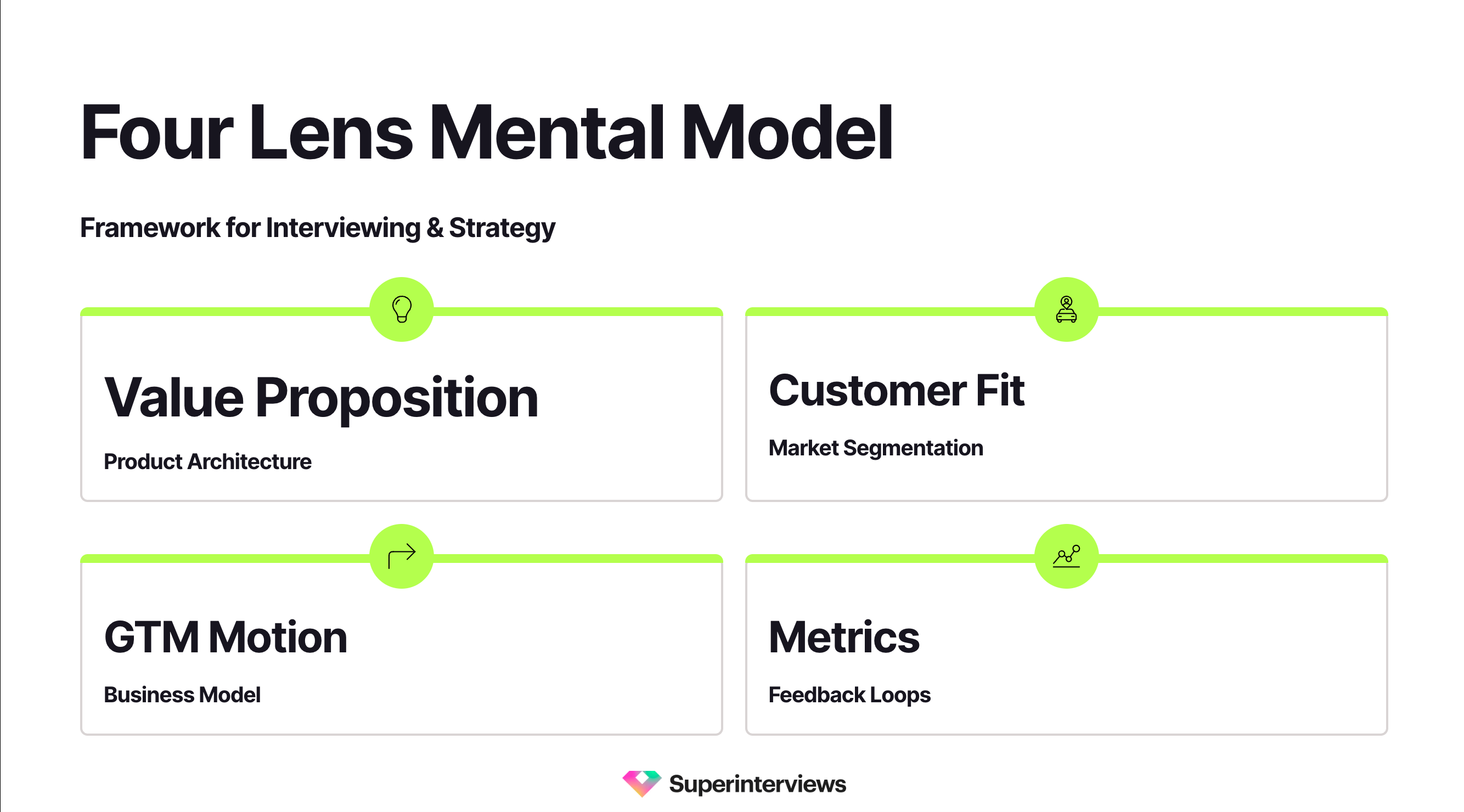
Pillar 1: Value Proposition
AI-native: You must explain model abstraction, data loops, and technical architecture. Technical fluency isn’t optional – you’re essentially a systems architect who’s also a strategic thinker and fantastic storyteller.
AI-enabled: Focus on ROI and customer outcomes. How do you translate tech capabilities into measurable business value?
Pillar 2: Customer Fit
AI-native: Developer-centric, early adopter-focused. Su shared that her startup targeted other AI startups because they’d already seen AI’s power and were willing to experiment.
AI-enabled: Existing customer retention. NRR > ARR. You’re working with customers who need trust-building and adoption support.
Pillar 3: Go-to-Market Motion
AI-native: Usage-based/token-based pricing models. Community evangelism is non-negotiable – your users build, teach, and amplify before they buy. Build comes before purchase.
AI-enabled: Sales enablement and ROI storytelling. Here’s the kicker: in traditional SaaS, ROI storytelling came AFTER adoption through case studies. In AI-enabled GTM, ROI storytelling drives adoption itself. Su’s example: HubSpot doesn’t say “we have AI-powered selling” – they say “save 10 hours weekly on follow-ups.”
Pillar 4: Metrics and Loops
AI-native: API calls, compute utilization, user growth. Developers are your distribution engine – adoption happens through builders, not buyers.
AI-enabled: Feature adoption, retention rates, time to value. Track productivity lifts and tier upgrades religiously.
This framework has helped companies get their go-to-market right. Use it in interviews to demonstrate strategic thinking that’s grounded in real operational understanding.
Need help positioning yourself around these pillars? The Super 50 Research in your Superinterviews dashboard breaks down exactly how target companies operate across these dimensions, so you walk into interviews speaking their language.
3. The Hidden Challenge That Tanks AI-Native Startups
Su got vulnerable about the biggest mistake her AI-native startup made: underestimating the education budget. They had massive top-of-funnel excitement – people were naturally curious about AI – but conversion rates were low because prospects either found it too complex or didn’t grasp the new paradigm.
The key insight: In AI-native, intensive education isn’t a nice-to-have marketing tactic. It’s the core of your GTM strategy. If you’re interviewing for AI-native roles, demonstrate that you understand this. Talk about how you’d structure developer education, community building, and hands-on experimentation programs.
Meanwhile, AI-enabled companies face a different challenge: change management. Customers are already doing the work your AI feature addresses. Your job is helping them understand not just what your AI does, but why changing their workflow is worth it. This requires killer storytelling about efficiency gains, personalization improvements, and tangible time savings.
In your interviews, show you understand these nuanced challenges. Don’t just say “I know AI GTM” – demonstrate you know which specific operational challenges you’ll be solving day one.
4. Why LinkedIn Is Your Secret Weapon (And Most People Blow It)
JB walked us through how your LinkedIn profile is quite literally your career’s landing page. It’s not just about getting interviews – it’s about getting leveled correctly once you pass those interview loops. A strong LinkedIn profile means the difference between an L4 and L5 offer, or between a product role and a strategic growth role.
Here’s what makes a LinkedIn profile actually work for AI GTM roles:
Clear narrative that shows you understand AI-native vs. AI-enabled contexts
Quantified impact that speaks to the specific metrics these companies care about
Strategic positioning that gets you discovered by the right recruiters
Most people’s LinkedIn profiles are resume dumps. They list responsibilities instead of demonstrating strategic thinking. They say “worked on AI features” instead of “drove 40% adoption of AI-powered workflows, reducing customer onboarding from 10 hours to 2 hours through automated agent systems” (like Su’s real example).
24-Hour Exclusive: Our LinkedIn Optimizer is normally $1,600 for 6 months. Today only, get LIFETIME access for $399 until you land your job. Your personal JB will review your profile and give you specific, actionable feedback on how to position yourself for AI GTM roles. That’s a $9,000 value for $399 – and it includes unlimited revisions until you’re 100% confident in your story.
Grab the LinkedIn Optimizer for $399 →
5. The Interview Question That Exposes Your Understanding
Su revealed the exact question she asks when interviewing AI GTM candidates: “How would you price this product?”
Your answer immediately tells her whether you understand the AI-native vs. AI-enabled distinction:
AI-native candidates ask: “What’s the token usage? What are the compute costs? How do we handle usage-based scaling?” They’re thinking about the technical infrastructure that drives pricing models.
AI-enabled candidates ask: “How do we prove ROI to the CFO? What’s the customer benefit story? How do we structure tier upgrades?” They’re thinking about value-based pricing and customer retention.
Both approaches are excellent – but only if they match the company you’re interviewing with. Know what game you’re playing.
This is exactly why our AI Mock Interviews are tailored to specific companies. When you practice for a Notion interview vs. an Anthropic interview, you get completely different questions and feedback because the contexts are fundamentally different. You don’t just practice answering questions – you practice thinking in the right strategic framework.
6. Community Evangelism vs. ROI Storytelling: The GTM Divide
This might be the most actionable distinction Su shared. Your go-to-market motion fundamentally changes based on your company type:
For AI-native companies: Community evangelism is your top priority. OpenAI, Hugging Face, and similar companies succeed because their early users don’t just buy – they build, teach, and amplify. The product is technical, evolving, and hard to evaluate upfront. You need developers and technical users to trust you enough to experiment, then advocate for you.
In interviews, talk about how you’d structure developer relations, open-source contributions, technical documentation, hands-on workshops, and community-led content. Show you understand that adoption turns into advocacy when done right.
For AI-enabled companies: Sales enablement and ROI storytelling are critical. Train your internal teams obsessively on how to articulate AI-powered features in terms of customer outcomes. Remember Su’s insight: in AI-enabled, ROI storytelling drives adoption rather than following it.
In interviews, demonstrate you know how to craft value narratives. Instead of saying “our AI feature does X,” you’d say “customers save 10 hours weekly doing Y.” You’re translating technical capability into business impact.
This distinction alone can make you stand out in interviews. Most candidates talk generically about “AI go-to-market.” You’ll talk specifically about community evangelism OR ROI storytelling based on the company’s context.
7. The Healthcare Example That Makes Everything Click
Su used a brilliant healthcare analogy to crystallize the difference:
AI-native: An AI-powered clinical reasoning engine that assists doctors with diagnosis. AI IS the value proposition. You’re selling a new way to practice medicine, powered by intelligent systems.
AI-enabled: An existing EHR (electronic health records) system that adds automated chart summaries and ICD-10/ICD-9 coding suggestions. AI ENHANCES what’s already there, making doctors more efficient in their existing workflows.
Same industry. Both using AI. Completely different GTM strategies, customer conversations, and success metrics.
Use this kind of concrete example in your interviews. When discussing your understanding of AI GTM, don’t just recite theory – use specific industry examples like Su did. It shows you’re not just memorizing frameworks; you’re applying them to real business contexts.
8. Why Technical Fluency Became Non-Negotiable for AI-Native GTM
Here’s something Su emphasized that many growth marketers miss: for AI-native products, you need to think like a systems architect. You’re not just a strategic thinker anymore – you need technical fluency to have credible conversations with the deeply technical buyers you’re serving.
As Su explained from her experience, when taking an AI-native product to market, you’re primarily talking to technical folks. Understanding data flows, technical nuances, and having platform ecosystem fluency isn’t optional – it’s table stakes. You can’t fake this in interviews.
But here’s the good news: you don’t need to become a machine learning engineer. You need to understand enough to ask intelligent questions and have credible technical conversations. You need to know what token-based pricing means, how model scaling works, what latency considerations matter to developers.
This is exactly what upskilling looks like for AI GTM. It’s not just marketing tactics – it’s developing enough technical literacy to earn credibility with technical audiences.
9. The Developer Retention Metric You’re Not Tracking
Su highlighted something crucial that most growth teams overlook: In AI-native companies, developers are your true distribution engines.
This changes everything about how you measure success. Traditional B2B SaaS metrics focused on sales pipeline and enterprise deals. AI-native success is bottoms-up adoption through builders, not buyers.
This means tracking:
Developer onboarding completion rates
Time to first API call
Monthly active developers (not just accounts)
Community engagement (GitHub stars, Discord activity, technical content consumption)
Developer-initiated expansion into enterprise accounts
When you’re interviewing for AI-native growth roles, show you understand this distinction. Talk about how you’d build for developer stickiness and how you’d turn technical users into advocates.
Meanwhile, AI-enabled metrics look more traditional but with specific twists: feature adoption rates, retention by AI tier, productivity lift measurements, and tier upgrade velocity. Show you know which metrics matter for which context.
10. The ChatGPT vs. Canva Case Study
Su compared ChatGPT’s Team Plan (AI-native) with Canva’s Magic Studio (AI-enabled) to show how two AI products sell completely differently:
ChatGPT’s Team Plan emphasizes intelligence, model capabilities, and what the AI can DO. The messaging centers on the power of the underlying technology, collaborative features for teams working with AI, and the sophistication of the model itself.
Canva’s Magic Studio emphasizes speed, ease of use, and how much faster users can create designs. The messaging focuses on outcomes – removing backgrounds instantly, generating images from text, resizing for multiple platforms automatically. They’re selling time savings and creative productivity, not AI sophistication.
Both are selling AI. But the positioning, messaging, customer conversations, and success metrics are fundamentally different.
Use this example in interviews when asked about competitive positioning or GTM strategy. It shows you can analyze real companies and extract strategic insights.
🎁 Your FREE AI GTM Resources
We’ve pulled together four incredible resources to help you level up immediately:
1. How To Upskill and Land an AI PM Role
Your complete guide to breaking into AI product management, covering everything from technical fundamentals to interview frameworks. This is the playbook for positioning yourself as someone who can bridge technical and business thinking.
2. How To Upskill and Land an AI Growth, Marketing Role
This guide breaks down exactly what differentiates AI growth roles from traditional marketing – including Su’s frameworks, real company examples, and specific skills to develop. Use this to map your current experience to AI GTM requirements.
Download the AI Growth & Marketing Guide →
3. AI-native Vs. AI-enabled Growth Guide By Su Belagodu
Su’s comprehensive breakdown of the strategic differences we discussed today. This is your reference guide for positioning yourself correctly in interviews and understanding which companies match your skill set.
Download the AI-native Vs. AI-enabled Growth Guide →
4. Join Our FREE Slack Community
Connect with 1,000+ top tech professionals who are collaborative, not competitive. This is where the real magic happens – warm introductions, interview practice, role referrals, and genuine support. Unlike the toxic competitive culture in some tech communities, ours is built on generosity and mutual success.
Join the Superinterviews Community →
⚡ Your 24-Hour Workshop Offer (Ends Soon!)
Here’s the thing: we know the job market is challenging right now, especially in AI GTM where roles are evolving faster than companies can write job descriptions. That’s exactly why we built Superinterviews – to give you an unfair advantage when it matters most.
Today Only: Superinterviews LinkedIn Optimizer
Get your LinkedIn optimized by your personal JB in less than a day and start getting recruiter inbound this week.
Normal Price: $1,600 for 6 months
Today’s Price: $399 one-time payment
What You Get: Full access to ALL features until you land your job (unlimited time)
Actual Value: $9,000+ (equivalent to elite coaching + profile optimization + ongoing support)
This includes: ✅ Personalized LinkedIn profile review and optimization
✅ Unlimited revisions until you’re 100% confident
✅ Strategic positioning for AI-native OR AI-enabled roles
✅ Keyword optimization for recruiter discovery
✅ Compelling narrative that gets you leveled correctly
✅ Access until you land your dream job (no time limit)
Get LinkedIn Optimizer for $399 →
This offer expires in 24 hours from the workshop end time. After that, it returns to $1,600.
🚀 Your Action Items This Week
1. Watch the Workshop Replay
If you missed any part or want to take notes on specific sections, the full recording is available. Su’s frameworks are worth watching multiple times.
Watch the Replay →
Connect with Su on LinkedIn →
2. Download All Four Free Resources
Each resource builds on the others. The AI PM guide, AI Growth guide, Su’s comparison framework, and Slack community access – grab all four while they’re fresh in your mind.
3. Identify 5 Target Companies
Using Su’s framework, categorize them as AI-native or AI-enabled. Write down which pillar (value prop, customer fit, GTM motion, metrics) each company emphasizes. This exercise will transform how you research companies and prepare for interviews.
4. Update Your LinkedIn (or Grab the Optimizer)
At minimum, review your current profile through the AI-native vs. AI-enabled lens. Are you clearly positioned? Does your experience speak to the metrics these companies care about? Or better yet, invest $399 today to have it professionally optimized.
5. Join the Community
This is free and might be the highest-ROI action you take this week. Our Slack community is where people find warm introductions, get interview referrals, and receive real-time feedback. Don’t job search in isolation.
🔗 Quick Links & Resources
Workshop Replay: Watch Here
Superinterviews Platform: Get Started
LinkedIn Optimizer ($399 Today Only): Grab It Now
Free Slack Community: Join the Conversation
AI PM Guide: Download
AI Growth Guide: Download
What’s Next?
Look, we get it. The AI GTM space is evolving FAST, and it can feel overwhelming trying to position yourself when companies are still figuring out what they need. But here’s what we know for sure: the candidates who understand the frameworks Su shared today – who can articulate the difference between AI-native and AI-enabled, who demonstrate strategic thinking grounded in operational reality – those are the candidates getting offers.
You showed up today. You invested your Halloween in your future. That already puts you ahead of most people who are just hoping things work out.
Now it’s time to take action. Grab the free resources. Join the community. And if you’re serious about getting recruiters reaching out to YOU instead of endlessly applying, invest $399 in the LinkedIn Optimizer today. It’s literally less than one nice dinner out, but it could be the difference between getting passed over and getting that first conversation.
We believe in you. The talent is there – now let’s make sure everyone else can see it too.
You got this!! 🚀
Kasey (Your Fairy Job Mother ✨)
Community & GTM, Superinterviews
P.S. Shout-out to everyone who participated in today’s chat, asked questions, and shared their Halloween costumes! Special recognition to those who engaged during the LinkedIn teardowns – your willingness to put yourselves out there is exactly the kind of energy that gets people hired. Keep that going.
And if you have questions or need help with anything – positioning, LinkedIn, understanding a specific framework – drop a note in our Slack community or shoot me an email. We’re in this together, and we’ve got your back.
P.P.S. If you’re already a Superinterviews customer and want access to today’s bonuses, send us an email at superinterviews@teamsidebar.com and we’ll get you sorted. The community takes care of each other around here.
This email contains everything discussed in today’s workshop. If anything was unclear or you’d like to dig deeper on a specific topic, the full replay is available and Su’s guides are waiting for you. Don’t let this momentum fade – take action while you’re still fired up from today’s session.